
Currently, the commonly used TS over IP transmission protocols in the market are primarily based on the UDP protocol. However, UDP is an unreliable transmission protocol that cannot address issues of jitter and packet loss over public networks. As a result, traditional TS over IP solutions are not applicable to ordinary internet transmission scenarios.
AppearTV has recently developed an input-output interface module based on the SRT internet transmission protocol, capable of supporting IP signal input and output using the SRT protocol. SRT aims to overcome the packet loss and ordering issues of UDP while eliminating the common buffering delays associated with TCP (Transmission Control Protocol). Both protocols utilize the latest version of the Transport Layer Security protocol, TLS 1.3, to ensure secure transmission.
SRT employs many variants of these technologies, including fast session establishment, bandwidth estimation, and low-latency retransmission techniques for handling packet loss recovery. When congestion levels are high, it mitigates the issue by dropping packets. However, SRT does not rely on HTTP and ABR to adjust the bitrate in response to changes in bandwidth availability; instead, it analyzes network conditions in real-time and filters out the effects of jitter, noise, and congestion.
From a practical application perspective, the SRT transmission protocol is sufficiently capable of serving as an alternative to satellite or dedicated links to a certain extent.
Here is an introduction to the AppearTV new SRT Internet Transmission Protocol module:
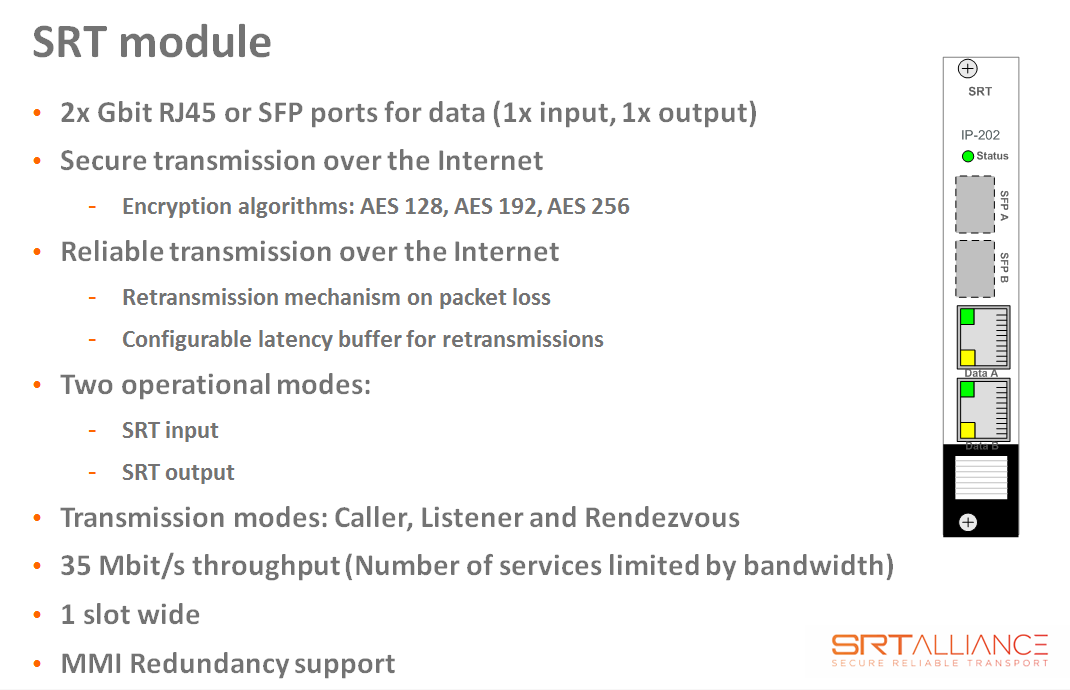
The SRT module is a new type of module added by AppearTV to its XC5x00 product line. It is fully compatible with the application extensions of other modules in the XC5x00 series. It can be combined with the encoding and decoding modules of the XC5x00 to form a complete internet transmission codec, or it can be integrated with various stream processing modules (such as descrambling, scrambling, modulation, volume equalization, etc.) to create a comprehensive internet transmission system. Its applications are diverse and can be flexibly expanded.